
The Discovery That Changed Materials Science
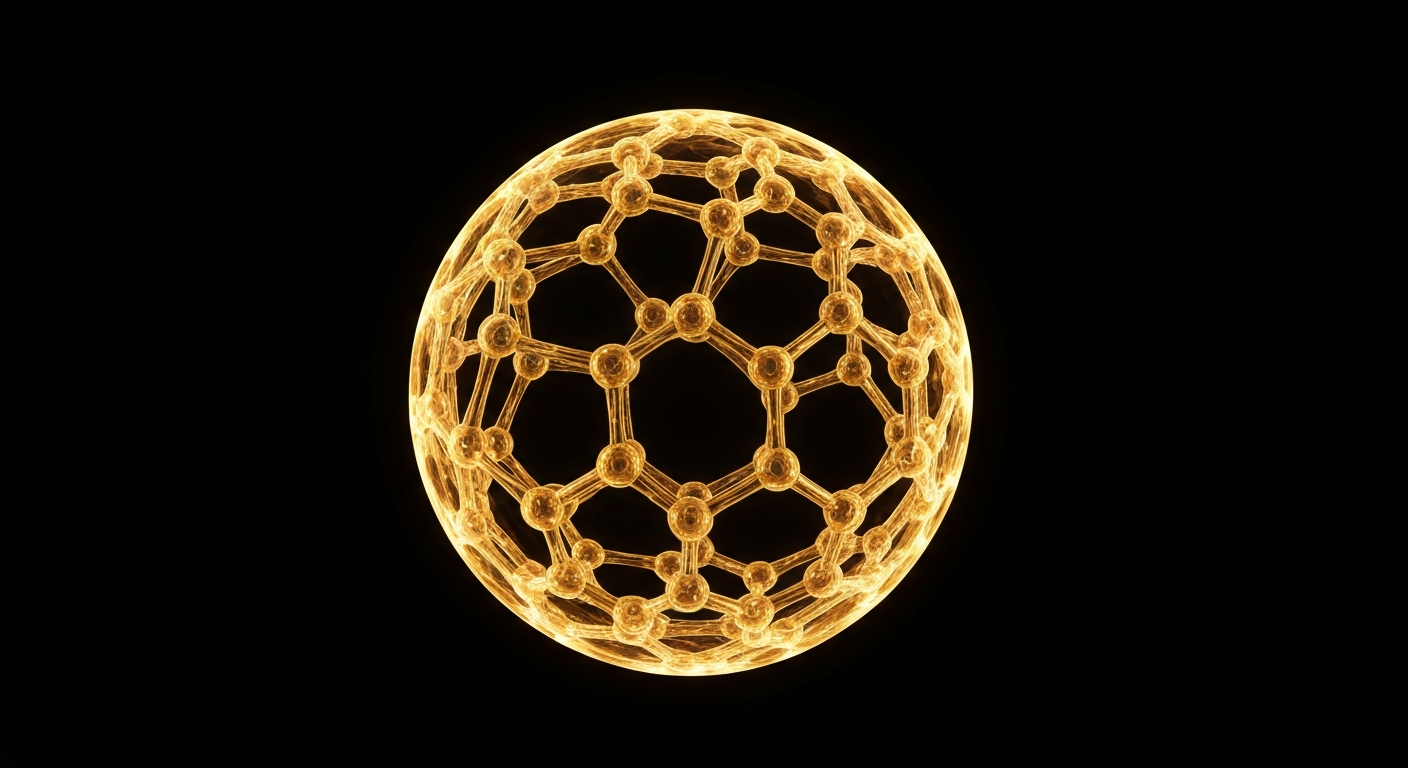
In 1985, scientists Harry Kroto, Richard Smalley, and Robert Curl discovered a previously unknown form of carbon — a perfectly symmetrical, hollow sphere made of 60 carbon atoms. They named it Buckminsterfullerene (C60), after the architect Buckminster Fuller, whose geodesic dome designs the molecule resembled.
The discovery earned a Nobel Prize in Chemistry in 1996 and opened an entirely new chapter in materials science, nanotechnology, and medical research.
The Geometry of C60
The C60 molecule is constructed from 20 hexagons and 12 pentagons arranged in the same pattern as a standard football. This icosahedral symmetry gives it a unique set of properties:
- •Extraordinary stability — the structure distributes stress across all 60 atoms equally
- •Electron absorption — C60 can absorb and manage free radical electrons with exceptional efficiency
- •Light interaction — its symmetric geometry allows it to interact with photons in a highly specific and repeatable way
This last property is what makes C60 uniquely suited to optical applications.
How C60 Transforms Light in Tesla Lenses
When C60 is applied as a nano-coating to an optical lens, it interacts with light passing through the lens at a molecular level. The result is what the technology's developers describe as "hyper-harmonization" — the restructuring of a disordered light spectrum into a coherent, organised format.
Think of it this way: unharmonised artificial light is like noise — a chaotic mix of frequencies with no coordinated structure. The C60 coating acts like a filter that organises that noise into a coherent signal. The photons exiting the lens are structured in a way that is biologically similar to natural sunlight.
This is fundamentally different from a tinted lens, which simply reduces the quantity of light. The C60 coating changes the quality of the light.
The 18 Billion Twists Per Second
One of the more remarkable properties of the C60 molecule in this context is its rotational behaviour under photon interaction. The molecule rotates at an extraordinarily high rate when processing light — a property that contributes to the consistency of the harmonisation effect across the full visible spectrum.
Antioxidant Properties and Biological Benefit
Beyond its optical properties, C60 is also one of the most potent antioxidant molecules ever studied. Research has shown that C60 can neutralise free radicals at a rate 172 times more effective than Vitamin C. While the primary mechanism in Tesla Glasses is optical, the presence of C60 at the lens surface adds an additional dimension to the product's biological relevance.
Why This Matters
Most optical advances over the last century have been about lens shape, material clarity, or coating hardness. The application of C60 nanotechnology to spectacle lenses represents a genuine paradigm shift — moving from optics as a mechanical science to optics as a biological interface.
Tesla Glasses are the product of this shift.