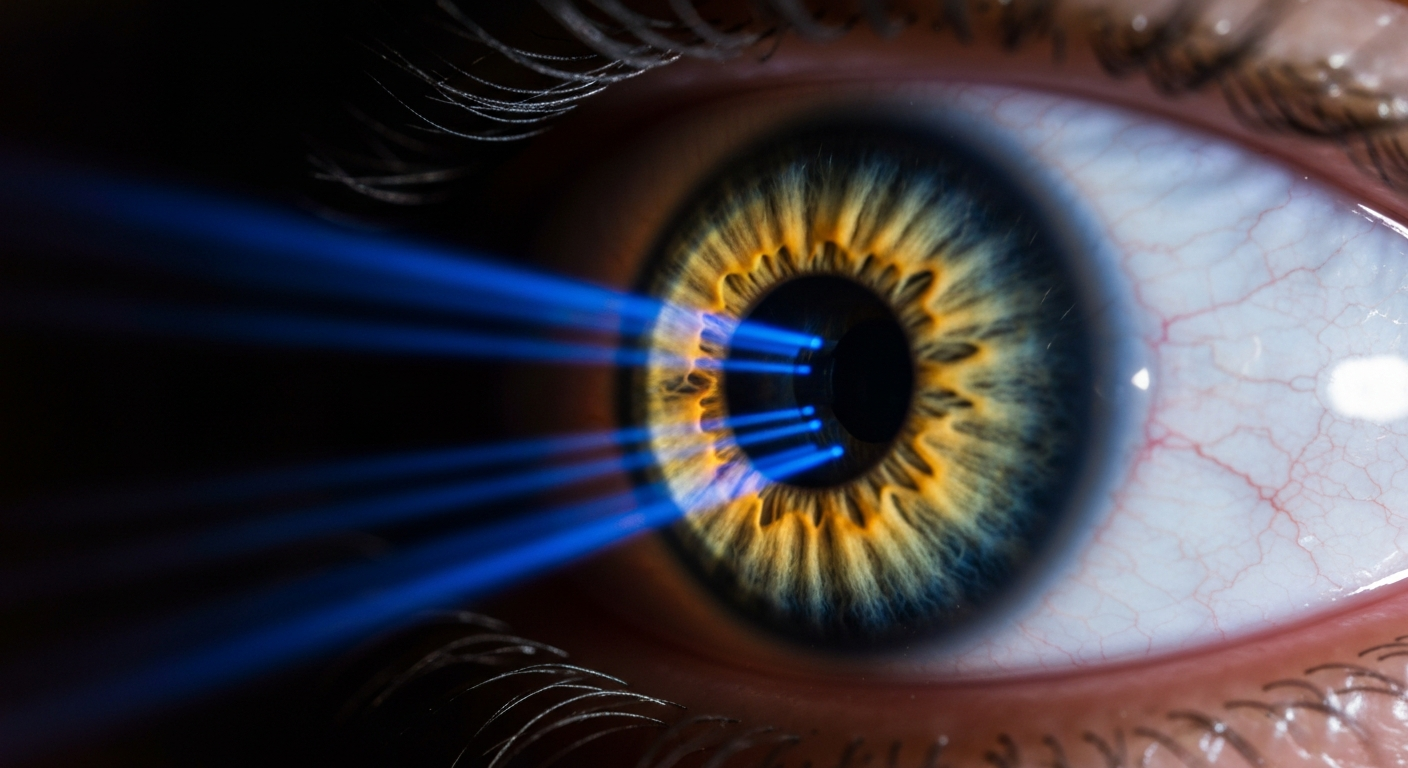
Millions of Americans have purchased screen fatigue eyewear, most of it marketed as blue light glasses, hoping to put an end to tired eyes, dull headaches, and that drained feeling that sets in by mid-afternoon. Most still end up with the same symptoms by Thursday.
That's not a coincidence.
The problem isn't that screen fatigue eyewear doesn't work at all. The problem is that most of it is built around an assumption the clinical evidence no longer supports. Screen fatigue is real, and the physiological mechanisms behind it are well understood. But the blue light narrative that launched an entire product category was always more marketing than medicine.
The actual causes of digital eye strain are more interesting than a single wavelength, and the solutions are more nuanced than a tinted lens with a clever name. This article walks through what's really driving your symptoms after a full day at a screen, which eyewear features genuinely help, and why one technology approaches the problem from an entirely different direction.
Why Blue Light Glasses Don't Actually Fix Screen Fatigue
The 2023 Cochrane systematic review analyzed 17 randomized controlled trials and reached a direct conclusion: blue-light filtering lenses probably make no difference to eye strain or sleep quality compared to standard lenses. This wasn't a fringe finding from one small study. Multiple double-masked randomized controlled trials have reached the same result, with no statistically significant reduction in symptoms after controlled computer tasks. A 2017 systematic review covering 118 studies found consistent results in the same direction.
The American Academy of Ophthalmology now actively states there is no scientific basis to recommend blue-light filtering lenses solely for screen use. That is a significant position from the leading ophthalmology authority in the country, and it is drawn from the same evidence base as the Cochrane review.
This doesn't mean all screen fatigue eyewear is useless. It means the reason conventional blue light glasses are sold is wrong. Once you understand that, the question of which eyewear to buy becomes a completely different conversation.
For a broader look at how the blue light blocking approach compares to light transformation technology, see Blue Light Glasses vs Light Transformation — What's the Difference?
The Real Root Causes of Screen Fatigue
Accommodation Strain
Your eyes focus on screens through constant, involuntary muscle contraction. The ciliary muscle sustains effort without rest during extended near-distance work. When it stays contracted too long, it cannot relax properly. The result is what researchers call spasm of accommodation: blurred vision, difficulty shifting focus to distance, and post-task headaches that build across the day.
This is the primary physiological driver of computer vision syndrome, and it has nothing to do with light wavelength.
Spectral Mismatch From Artificial Light
Modern LED screens produce light with spectral peaks and elevated correlated color temperatures that differ meaningfully from natural daylight. That mismatch creates perceptual noise. The nervous system continuously compensates for it, which contributes to cognitive fatigue and visual tension that sits underneath the more obvious symptoms.
For a deeper breakdown of how artificial light affects neural processing and brain function, see How Light Affects Your Brain and Eyes — The Science Explained.
Reduced Blink Rate
A healthy blink rate sits at around 15 blinks per minute under normal conditions. During screen use it typically drops to around 5. Fewer blinks means the tear film doesn't get replenished, leading to dryness, surface irritation, and blurred vision, which then forces the eyes to work even harder to maintain focus.
These three mechanisms work together, which is why addressing only one of them, or addressing the wrong one entirely, is why most computer glasses disappoint. For a full breakdown of each cause and how they interact, see Eye Strain and Screen Fatigue — What Is Actually Causing It.
Lens Features That Actually Help
Anti-Reflective Coating
Anti-reflective (AR) coating is the single most effective upgrade available in screen fatigue eyewear. AR coatings reduce reflected light from screen surfaces and overhead lighting, the primary source of visual glare that forces the eye to work harder throughout the day. Unlike blue-cut lenses, the evidence for AR coatings improving visual comfort is consistent and supported by clinical guidance from the American Optometric Association and the American Academy of Ophthalmology.
Any serious pair of computer glasses should treat a quality AR coating as a baseline, not an optional add-on.
Anti-Fatigue Lenses
Anti-fatigue lenses, sometimes called low-add or enhanced single-vision lenses, address the accommodation problem directly. They incorporate a subtle power boost in the lower portion of the lens that reduces the focusing effort required during near tasks. The ciliary muscle gets partial relief without the wearer needing full progressive lenses.
These are particularly effective for people under 40 who don't yet need multifocals but experience accommodation strain after heavy screen use. If your headaches tend to build over the course of the day rather than appearing immediately, this is the mechanism worth targeting first.
A Proper Eye Exam
A comprehensive eye exam focused on computer vision syndrome is often the most efficient move anyone can make. The American Optometric Association recommends assessing visual acuity, refraction, accommodation, and vergence at working distance specifically, not just for general clarity.
Many screen fatigue cases stem from uncorrected low astigmatism in the 0.50 to 1.00 diopter range that standard distance prescriptions don't address at screen distance. A well-fitted prescription with an AR coating often resolves symptoms that months of over-the-counter screen glasses cannot touch.
Light Transformation vs. Light Blocking: A Different Approach
There is a meaningful difference between filtering out part of the light spectrum and restructuring light into a format the visual system can process more efficiently.
Conventional blue light glasses do the former: they remove specific wavelengths, sometimes shifting color perception without addressing the underlying spectral imbalance that creates fatigue in the first place.
Light transformation works on a different principle. Rather than dimming or cutting certain frequencies, it aims to convert incoherent artificial light into a more biologically compatible signal.
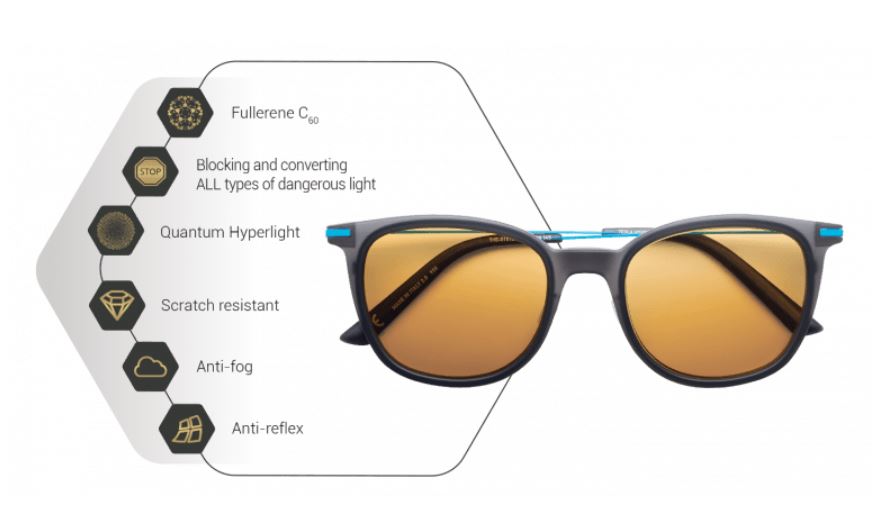
Tesla Glasses' Quantum Hyperlight Optics® uses patented Fullerene C60 nanotechnology embedded in the lens to harmonize the full light spectrum into a more coherent format. The lens doesn't block blue light; it works to restructure the light signal at the molecular level. The Indoor Collection, with 15% Fullerene shading, is designed specifically for office and screen environments and evening use, where the quality of the light signal is intended to support both visual comfort and healthy wind-down before sleep.
A 2019 EEG study published through the National Academy of Sciences of Ukraine by Gritsenko et al. reported measurable improvements in brain synchronization, memory processing, and nervous system balance in participants wearing these lenses. The quality of the light signal reaching the brain may have downstream effects on cognitive performance, a hypothesis supported by that research and worth weighing alongside the accommodation and glare evidence.
To understand the science behind those findings in more detail, see What Happens to Your Brain When You Wear Tesla Glasses? The EEG Study Explained.
For readers interested in broader research on light, recovery, and neural effects, see Light Therapy, Recovery, and Inflammation — What the Research Shows.
Choosing Screen Fatigue Eyewear: What to Prioritize
Screen fatigue doesn't present the same way for everyone, and the right starting point depends on your specific symptom pattern.
Headaches that build over two to three hours of screen work usually point to accommodation strain. Anti-fatigue lenses or an updated prescription with an AR coating are the first move.
Glare sensitivity and visual tension respond best to a quality AR coating. These are the most evidence-backed interventions available for computer vision syndrome, and also the most underpromoted, because they are less marketable than a blue light story.
Cognitive fogginess, difficulty winding down after evening screen use, and a generalized neural fatigue that outlasts the visual symptoms are a different set of signals. Those may point toward spectrum quality rather than accommodation or glare alone. That is the area where light-transforming lenses are specifically positioned. The Indoor Collection was designed for extended screen environments where the quality of the light signal, not just its intensity, may be affecting how your brain processes information across the day.
If you are unsure which collection suits your daily environment, the What Lenses Should You Choose? Indoor, Outdoor, or Hybrid? guide walks through each option clearly. You can also take the Find Your Perfect Pair quiz for a personalized recommendation based on how you actually spend your day.
Non-prescription screen glasses with AR coating and anti-fatigue add power are a reasonable starting point for people with normal or well-corrected vision. They won't help someone with undetected astigmatism, though. If over-the-counter options haven't delivered results after a few weeks of consistent use, an optometrist exam focused on computer vision syndrome is the more efficient path forward.
The Smarter Question to Ask Before Buying
Screen fatigue is not a blue light problem. It is an accommodation problem, a spectrum quality problem, and in many cases a nervous system load problem. Eyewear that targets only one narrow wavelength range is, at best, a partial solution.
The better question isn't "which blue light glasses should I buy?" It's "what does my visual system actually need after eight hours in front of a screen?"
For some people, the answer is an AR coating and an updated prescription. For others, especially those experiencing cognitive fatigue and disrupted sleep alongside visual fatigue, a lens that transforms light rather than simply filters it is worth a serious look.
Start with AR coating and anti-fatigue add power as your foundation. If you have already tried those options and still feel the drain, the Tesla Glasses Indoor Collection, built on patented Fullerene C60 nanotechnology and supported by EEG research, represents a different category of solution. Explore the science behind Quantum Hyperlight Optics® or browse the Indoor Collection to see whether it fits your situation.
*Tesla Glasses are a wellness product designed to support general wellbeing. They are not intended to diagnose, treat, cure, or prevent any medical condition. See our Medical Disclaimer for full details.*